
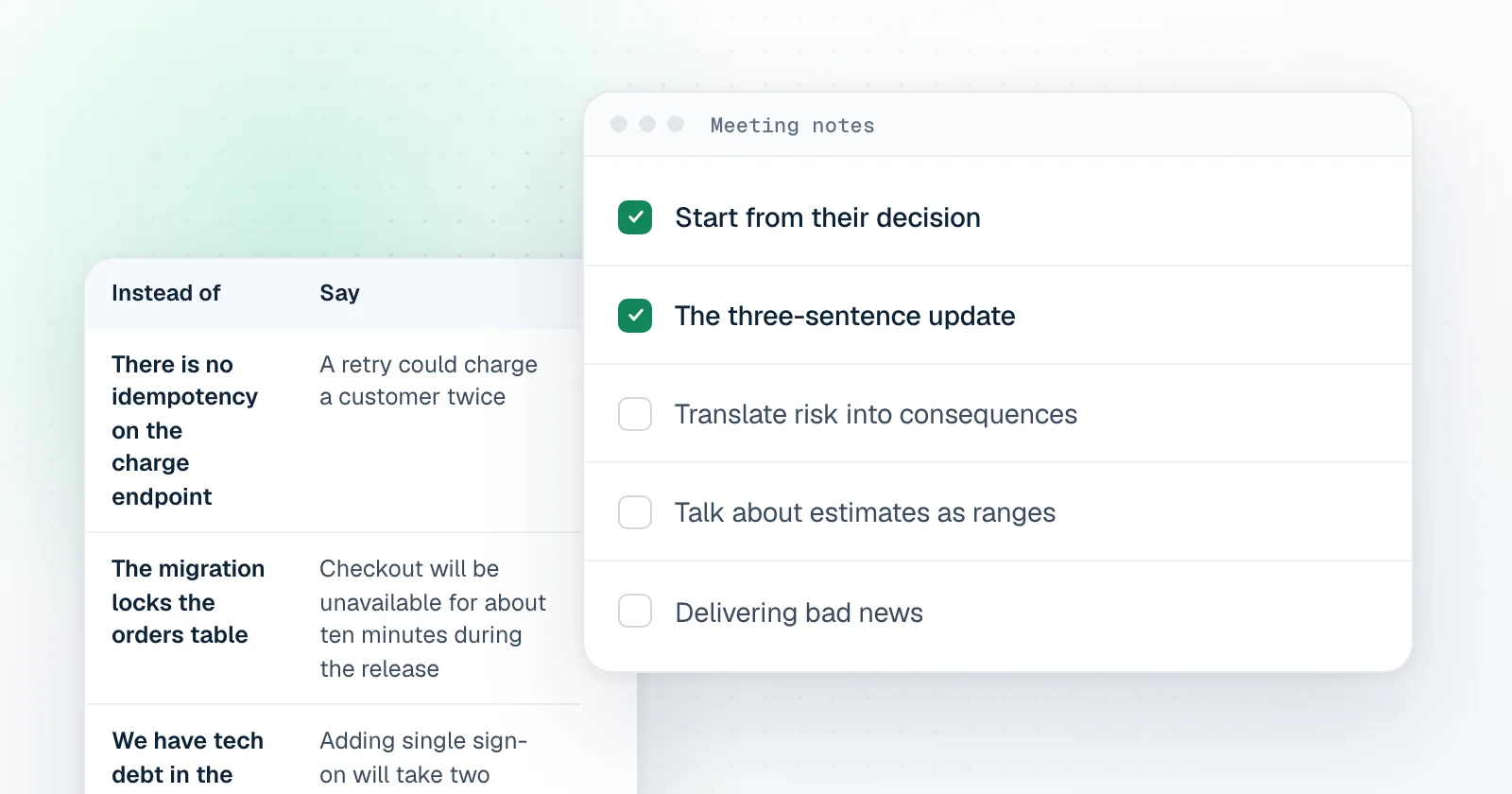
Start from their decision
Before you explain anything, ask yourself what this person has to decide or do with the information. Approve a date? Tell a customer? Choose between two options? Everything you say should help with that one thing. The rest is detail they will ask for if they want it.
The three-sentence update
- Where it is: on track, at risk or late, said plainly.
- What changed since last time, in terms of what they will see.
- What you need from them, if anything.
"The new checkout is at risk for the 1 December date. Payments can now be retried safely, but testing found a problem with refunds that needs another week. I need a decision by Friday: launch without the new refund screen, or move the date."
Translate risk into consequences
| Instead of | Say |
|---|---|
| There is no idempotency on the charge endpoint | A retry could charge a customer twice |
| The migration locks the orders table | Checkout will be unavailable for about ten minutes during the release |
| We have tech debt in the auth module | Adding single sign-on will take two weeks longer than it would on cleaner code |
| The cache can serve stale data | A price change can take up to five minutes to show on the site |
Talk about estimates as ranges
A single date is heard as a promise. A range with its reason is heard as a plan: "Two to three weeks. It is three if the payment provider takes as long to approve us as last time." Then say when you will know more. Stakeholders can work with uncertainty. They cannot work with surprises.
Delivering bad news
- Say it early. Bad news gets worse with every week it waits.
- Lead with the news, not the background.
- Bring options with their costs, not just the problem.
- Say what you are doing so it does not happen again, in one sentence.
Words to drop
Acronyms, internal service names and phrases like refactor, edge case or race condition, unless you explain them on the spot. If a word needs a second technical word to explain it, find another way. The test is whether they could repeat your explanation to their own manager.