
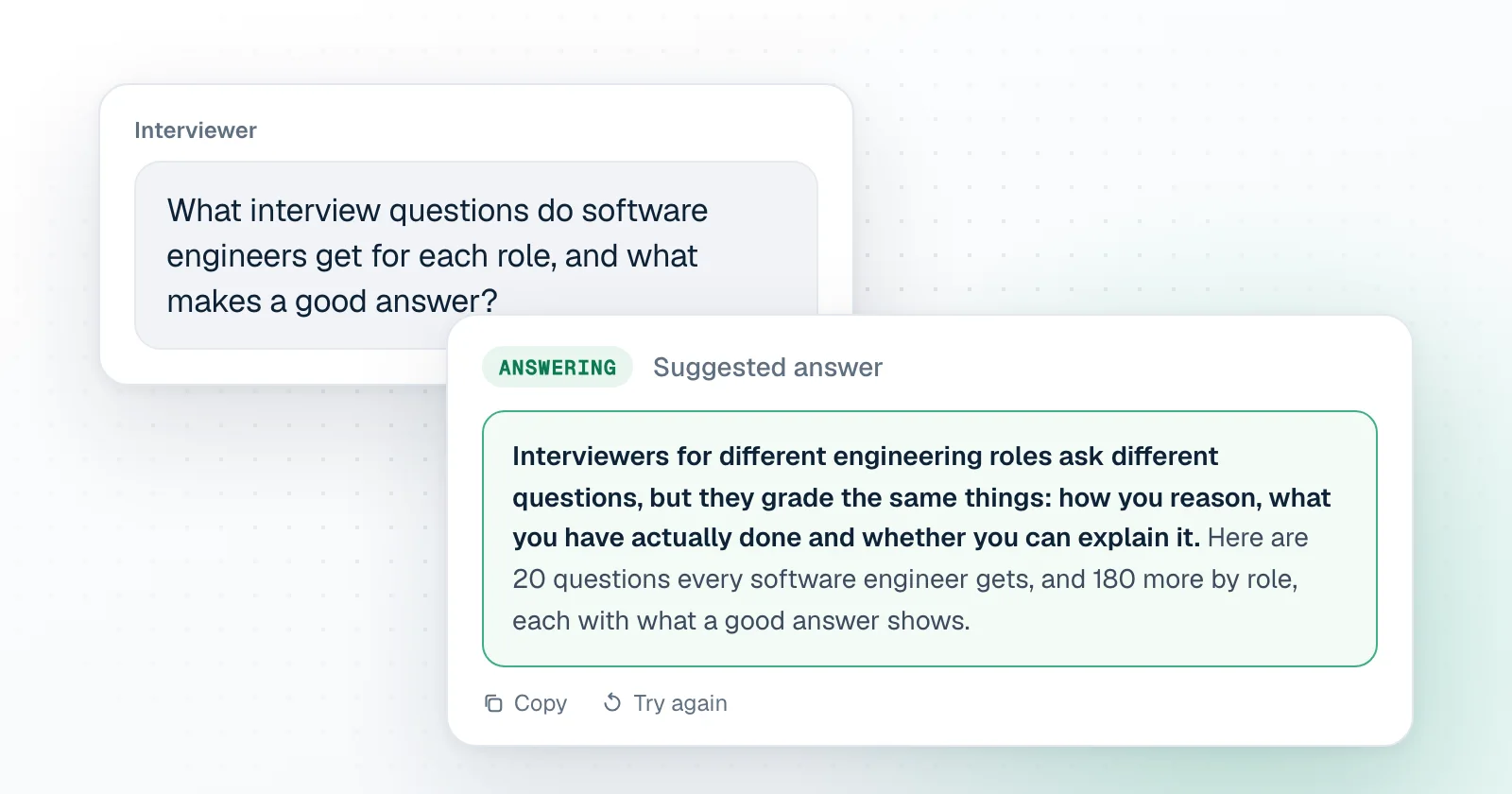
Questions by role
- Backend developer interview questions: 30 questions. APIs, databases, reliability, security and production debugging.
- Frontend developer interview questions: 30 questions. The browser, JavaScript, components and state, performance and accessibility.
- DevOps and SRE interview questions: 30 questions. Linux and networking, containers, pipelines, observability and incidents.
- Data engineer interview questions: 30 questions. SQL and modeling, pipelines, data quality, storage and processing.
- Mobile developer interview questions: 30 questions. The app lifecycle, architecture, networking and offline use, performance and releases.
- Machine learning engineer interview questions: 30 questions. Fundamentals, data and features, models in production and LLM systems.
About your work
- Tell me about yourself. A good answer takes about 90 seconds: what you do now, one achievement with a number, and why this job. See a 90-second answer.
- Walk me through a project you are proud of. A good answer covers the problem, your own part, one decision you made and why, and the result. See explaining a past project.
- What is the hardest bug you have fixed? A good answer tells how you narrowed it down, not only what the fix was. See telling a debugging story.
- Tell me about a decision you made without all the information. A good answer says what you knew, the risk you accepted and how you checked afterwards.
- What would your last team say you do best? A good answer names one strength with an example a teammate would recognize.
- Tell me about a time you were wrong. A good answer covers the mistake, how you found out and what you changed.
- Why are you leaving your current job? A good answer looks forward, is honest and does not complain. See three questions everyone hates.
Technical judgment
- How do you decide that code is ready to ship? A good answer weighs risk: tests on what matters, how easy the change is to undo, and how you will know if it breaks.
- How do you estimate a task? A good answer breaks the work down by what it touches, names the unknowns and gives a range. See estimating from what the change touches.
- What do you look for in a code review? A good answer checks correctness and risk first, then readability and tests, and leaves style to tools.
- How do you learn a new codebase quickly? A good answer runs it, traces one request end to end, reads the tests and asks targeted questions. See your first weeks on a new codebase.
- Tell me about a time you made something simpler. A good answer says what was removed and the measured effect.
- How do you handle technical debt? A good answer makes it visible, ties it to a cost the team feels and pays it down alongside feature work.
- How would you design a URL shortener? A good answer clarifies requirements, estimates the scale, starts with a simple design and then finds the bottlenecks. See a structure for system design.
Working with people
- Tell me about a disagreement with a teammate. A good answer shows you understood their view, used evidence, reached a decision and kept the relationship.
- How do you handle unclear requirements? A good answer asks questions, writes down assumptions and builds the smallest thing that tests them.
- Tell me about a time you helped someone grow. A good answer names what you did and what changed for them.
- How do you say no to another team's request? A good answer explains the trade-off and offers an alternative or a date.
- Tell me about a deadline you missed or nearly missed. A good answer covers the early warning, what was cut and what you learned about estimating.
- Do you have any questions for us? A good answer asks about the team's work and how success is measured, not only perks. See questions worth asking.
What good answers have in common
- Specific. One real situation, not what you would usually do.
- Your part. What you did, said plainly, even when it was a team effort.
- A result. A number, a date or a change someone noticed.
- A trade-off. What you gave up, and why it was worth it.
- Short. One to two minutes, then let them ask the follow-up.
How to practice these
- Pick the five questions you would find hardest, not the ones you already know.
- Answer each one out loud in about two minutes, and record yourself if you can.
- Compare your answer with the note: did it cover what a good answer shows?
- For every question, write down one real example from your own work that you could use.
For interviewers: the notes work as a scoring guide. Decide before the interview what a strong answer covers, and score the evidence you heard, not the confidence it was said with. See how to run a fair technical interview.