
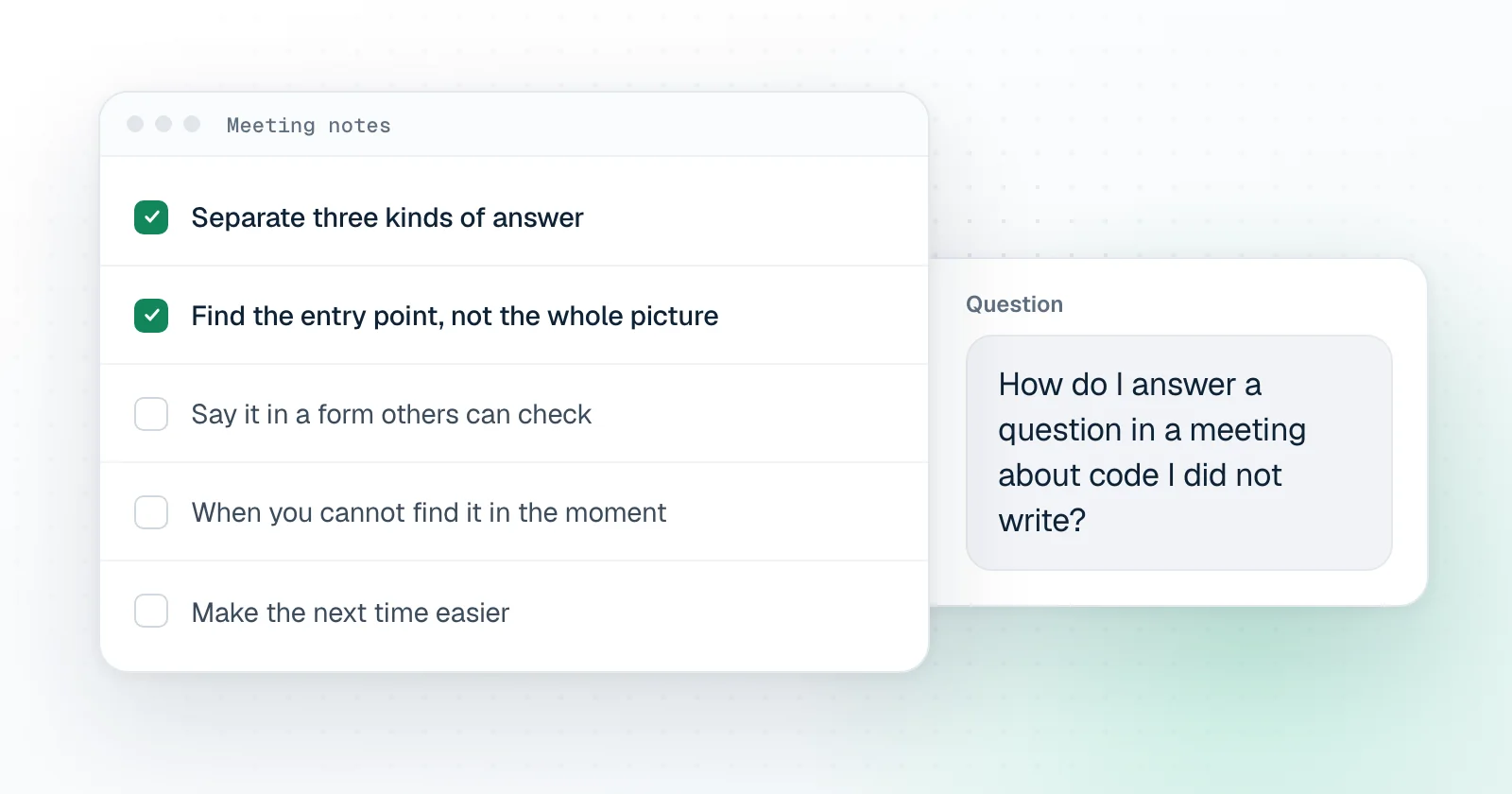
Separate three kinds of answer
- What the code does today. A fact. You can look it up.
- Why it was built that way. History. It lives in commit messages, pull requests and the memory of whoever wrote it.
- What it would take to change. An estimate. It depends on the first two.
Most bad answers mix these. "It makes one attempt and marks the job failed" is a fact. "It should be easy to change" is a guess in the same tone of voice. Say which one you are giving.
Find the entry point, not the whole picture
- Start from the word people used in the meeting: an endpoint path, a job name, a table, an error message. Search for it exactly.
- Open the place where it enters the system: the route, the handler, the queue consumer.
- Follow one call down until you reach the line that does the thing being asked about.
- Stop there. You need one path, not the map.
Say it in a form others can check
- Instead of "I think it retries", say "The consumer in queue/consumer.ts makes one attempt and marks the job failed. I see no retry there."
- Instead of "That should be fine", say "I checked the charge function. I have not checked refunds."
- Name the file. It lets the room verify you, and it is the fastest way to earn trust on code you did not write.
When you cannot find it in the moment
Say what you will check and when. "I can confirm that ten minutes after this call" is a good answer. A guess is fine too, as long as you call it a guess. What costs you later is a guess that sounded like a fact.
Make the next time easier
- Keep a short note per area: where it starts, which tables it touches, who knows it.
- Read the tests. They show what the author meant the code to do.
- Ask the author once, then write the answer where the next person will find it.