
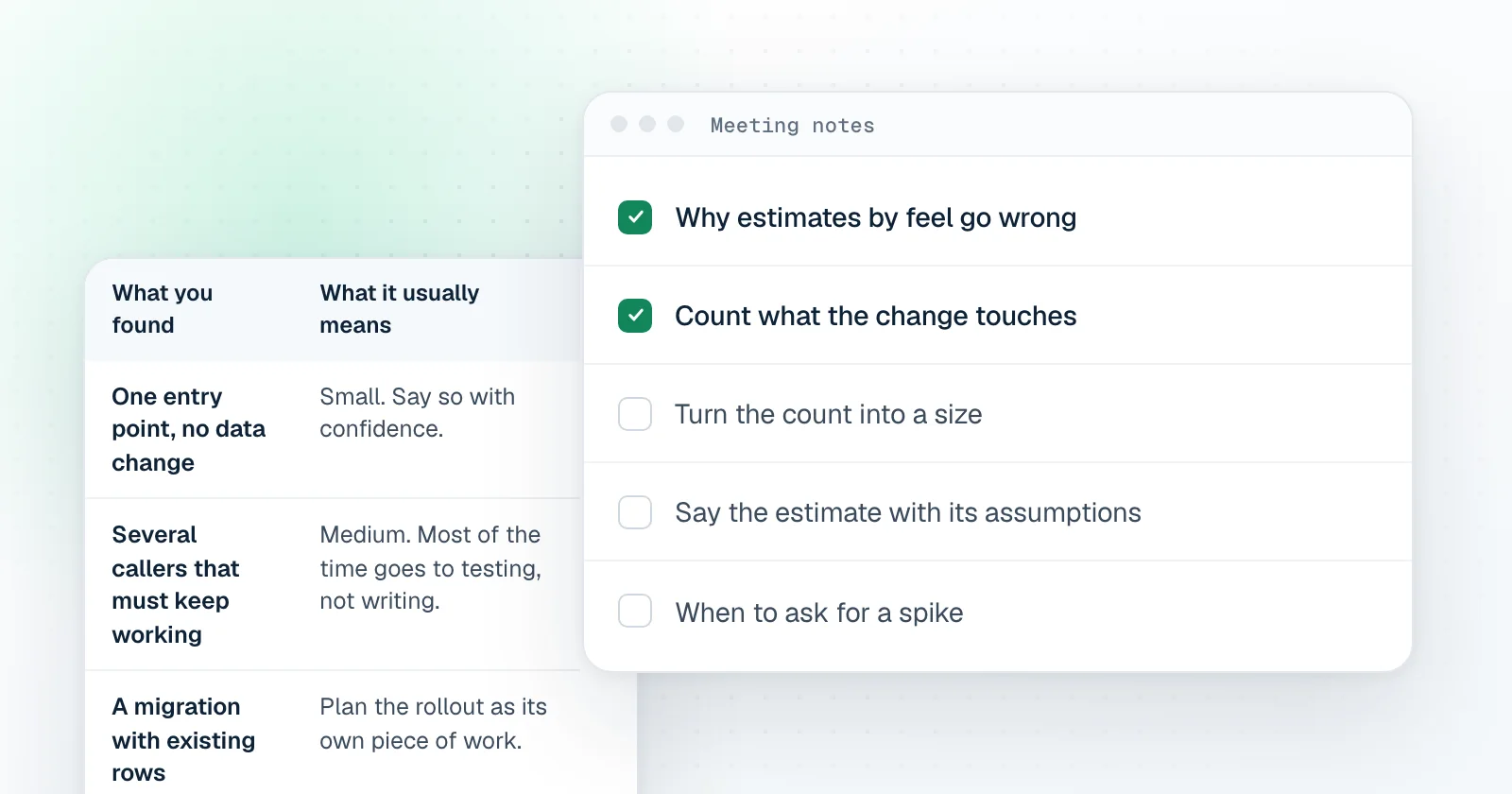
Why estimates by feel go wrong
The request arrives in product words: "add single sign-on". The cost lives in code words: session handling, the user table, the middleware every request passes through. The gap between the two vocabularies is where estimates break.
Count what the change touches
- Entry points. Which routes, handlers, jobs or screens have to change?
- Data. Which tables or columns? Is there a migration, and what happens to the rows that already exist?
- Callers. Who else calls the thing you are about to change? Search for its usages before you promise anything.
- Tests. Are there tests around it? If not, the first part of the work is writing them.
- Edges. Permissions, error paths, old clients, background jobs that read the same data.
Turn the count into a size
| What you found | What it usually means |
|---|---|
| One entry point, no data change | Small. Say so with confidence. |
| Several callers that must keep working | Medium. Most of the time goes to testing, not writing. |
| A migration with existing rows | Plan the rollout as its own piece of work. |
| No tests around the area | Add the time to write them first. |
| You could not find where it lives | Not ready to estimate. Ask for a short investigation. |
Say the estimate with its assumptions
A number alone invites an argument. A number with its assumption invites a decision: "Two to three days if we keep the current session table. If sessions have to be migrated, that is a separate ticket." Give a range and say what would move it.
When to ask for a spike
If five minutes in the code did not give you the entry point and the data it touches, the honest estimate is a time-boxed investigation: half a day to find out, then a real number. Teams accept this more easily than a confident number that doubles later.