
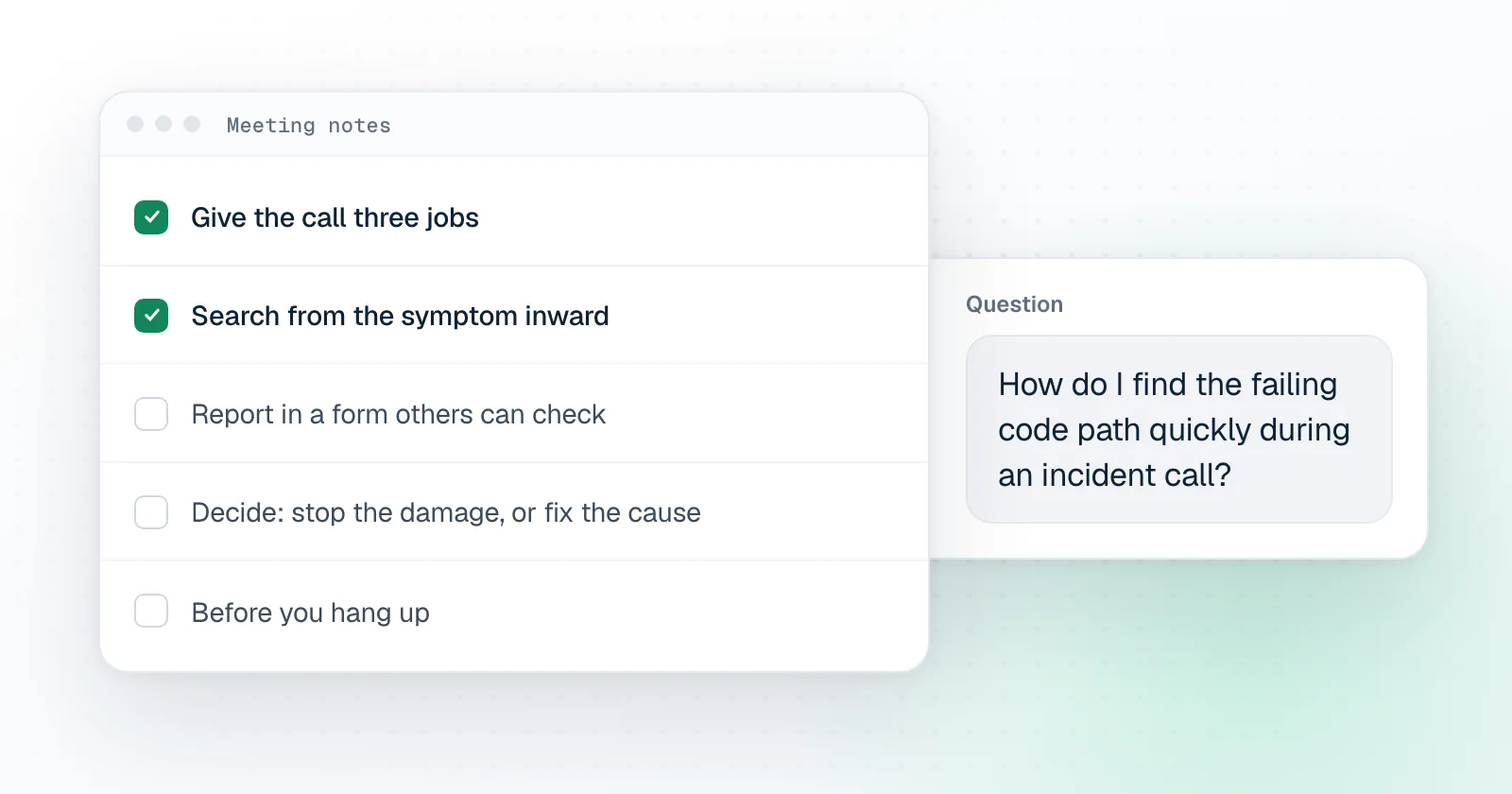
Give the call three jobs
- One person leads. They decide, keep time and say what happens next.
- One person traces the code. Screen shared, thinking out loud.
- One person talks to the outside. Customers, the status page, the rest of the company.
If you are tracing, you are not also leading. The moment one person does both, the call stops moving.
Search from the symptom inward
- The exact error text or status code that users see.
- The log line that goes with it, and the function that writes that line.
- The caller of that function and the inputs it was given.
- What changed recently in that file: the last deploy, the last few commits.
- The setting or flag that controls the behavior.
Report in a form others can check
"I think it is the gateway" gives the room nothing to do. "payments/charge.ts throws when the gateway times out, and the consumer does not retry" gives them a line to read and a decision to make. Say what you ruled out as well, so nobody checks it twice.
Decide: stop the damage, or fix the cause
- Can we turn it off with a flag?
- Can we roll back the last deploy?
- Is data being damaged right now, or only delayed?
If any answer points to a fast way of stopping the damage, take it first. The cause can wait an hour. Customers cannot.
Before you hang up
- Write the timeline while everyone still remembers it.
- List the action items, each with an owner and the files it touches.
- Note what monitoring would have told you earlier.