
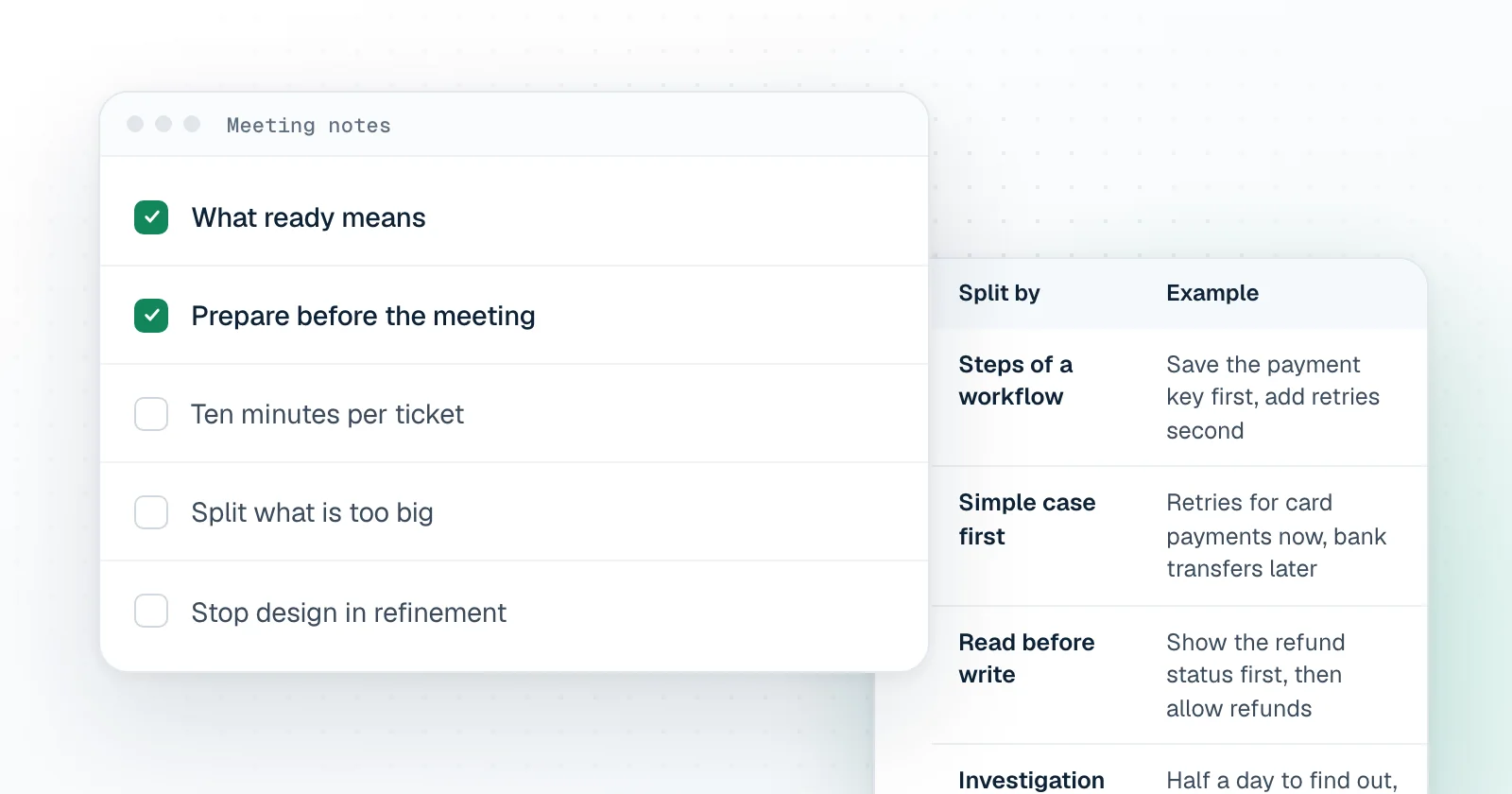
What ready means
- The problem is stated in terms of a user or a system, not as a solution.
- There is a clear way to tell when it is done.
- The parts of the code it touches are named.
- Open questions have an owner, or there are none.
- It is small enough to finish within one sprint.
Write your team's version down. A ticket that does not meet it is not discussed, it is sent back with a question.
Prepare before the meeting
The person who wrote the ticket reads it again the day before and fills the gaps they can. One engineer looks at the code for five minutes and adds which files and tables are involved. Those ten minutes of preparation save most of the meeting.
Ten minutes per ticket
- The author explains the problem in two minutes.
- The team asks questions until everyone could explain it back.
- Agree how you will know it is done.
- Estimate, or decide it needs splitting or investigating first.
- If the ten minutes run out, it is not ready. Note the open question and move on.
Split what is too big
| Split by | Example |
|---|---|
| Steps of a workflow | Save the payment key first, add retries second |
| Simple case first | Retries for card payments now, bank transfers later |
| Read before write | Show the refund status first, then allow refunds |
| Investigation and build | Half a day to find out, then a real ticket |
Each piece should be useful or at least safe to release on its own.
Stop design in refinement
When two people start drawing the solution, say "this needs a design discussion" and book one. Refinement decides what and how big. How is a different meeting with fewer people.
Estimating
Use whatever unit your team prefers, but estimate against what the change touches in the code, not how the request sounds. When estimates differ widely, the person with the highest and the lowest each say why. That conversation is the real value of estimating.