
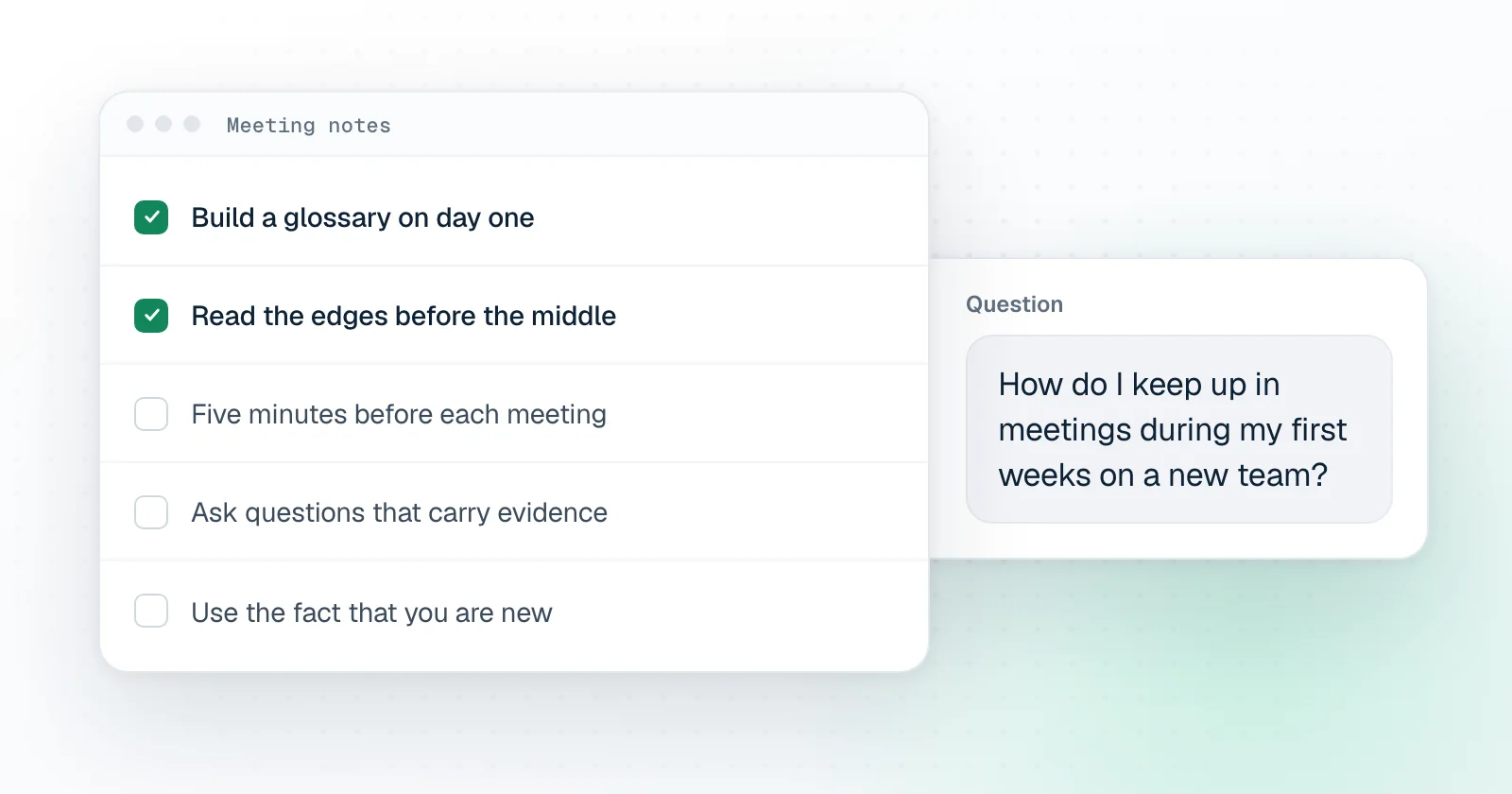
Build a glossary on day one
Every team runs on a few dozen words: service names, table names, acronyms, the nickname of the old billing system. Write each one down with a single line and the place it lives in the code. This list will carry you through more meetings than any architecture diagram.
Read the edges before the middle
- Routes and endpoints. What the outside world can ask the system to do.
- Jobs and queue consumers. What the system does on its own.
- The database schema. What it remembers.
The middle, where the clever code is, can wait. Most meeting questions are about the edges.
Five minutes before each meeting
- Read the agenda or the ticket.
- Search the code for the two or three names in it, and open where each one starts.
- Write one question.
Ask questions that carry evidence
"How do orders work?" asks someone to give a lecture. "I see orders are written in two places, checkout and the admin tool. Is that on purpose?" shows that you looked, and it often finds something real.
Use the fact that you are new
You are the only person on the team who can still see what is confusing. Write down what the README did not tell you and what the setup script got wrong. Fixing those is a good first contribution, and the next new person will thank you.
What to stop worrying about
Nobody expects you to know the history. "I have not read that part yet" is a complete sentence. Say it early and often, and replace it with "I read that part yesterday" as the weeks go on.