
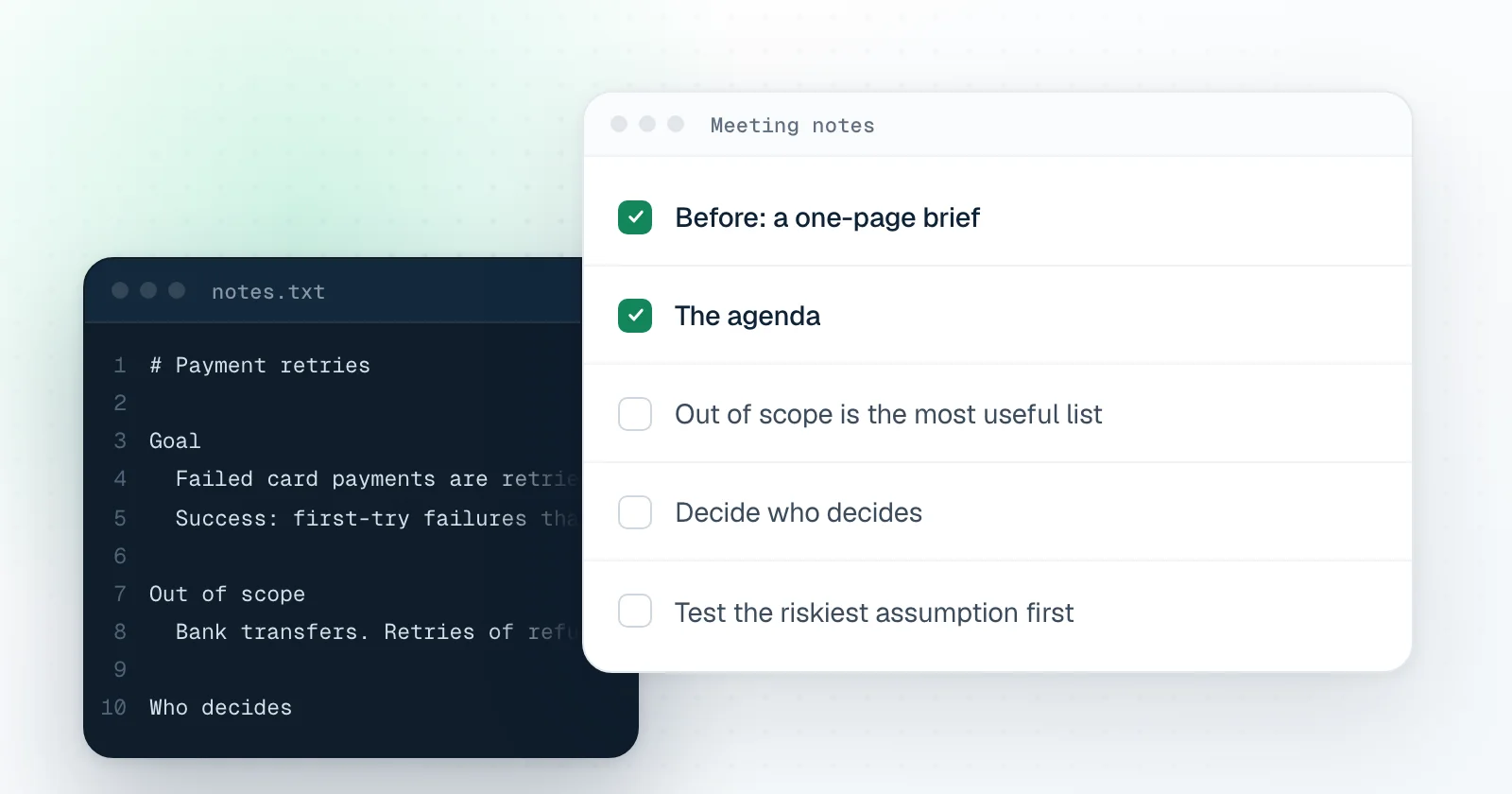
Before: a one-page brief
# Payment retries

Goal
  Failed card payments are retried safely, so fewer orders fail.
  Success: first-try failures that end in a paid order go from 0 to 80%.

Out of scope
  Bank transfers. Retries of refunds. A new checkout screen.

Who decides
  Scope: product manager. Design: tech lead. Launch date: both.

Riskiest assumption
  That a retry can never charge twice. Test this first.

Dates
  Design review 25 November. First release behind a flag 6 December.

Open questions
  Does the payment provider limit retries per card?
The agenda
- The goal and how you will measure it. Ten minutes. Everyone should be able to say it in one sentence.
- Out of scope. Ten minutes. The most useful list in the brief.
- Who decides what. Five minutes.
- The riskiest assumption and how to test it first. Fifteen minutes.
- The first two weeks, with names. Ten minutes.
- Open questions, each with an owner. Ten minutes.
Out of scope is the most useful list
Saying what the project will not do prevents more arguments than saying what it will. Every item on the list is a conversation you will not have to have in week six, when someone assumed it was included.
Decide who decides
For each kind of decision, name one person. Not a group, a person. Everyone can give input. When two people think they own the same decision, the project stalls the first time they disagree.
Test the riskiest assumption first
Ask what, if it turned out to be false, would make the whole plan wrong. Then make testing it the first piece of work, before anything that depends on it. A week spent proving the risky part early is cheap. A month spent building on a false assumption is not.
After the kickoff
- Update the brief with what changed in the meeting, the same day.
- Put it where the team will find it, next to the tickets or in the repository.
- Look at it again at the first review. If the goal has drifted, say so then.