
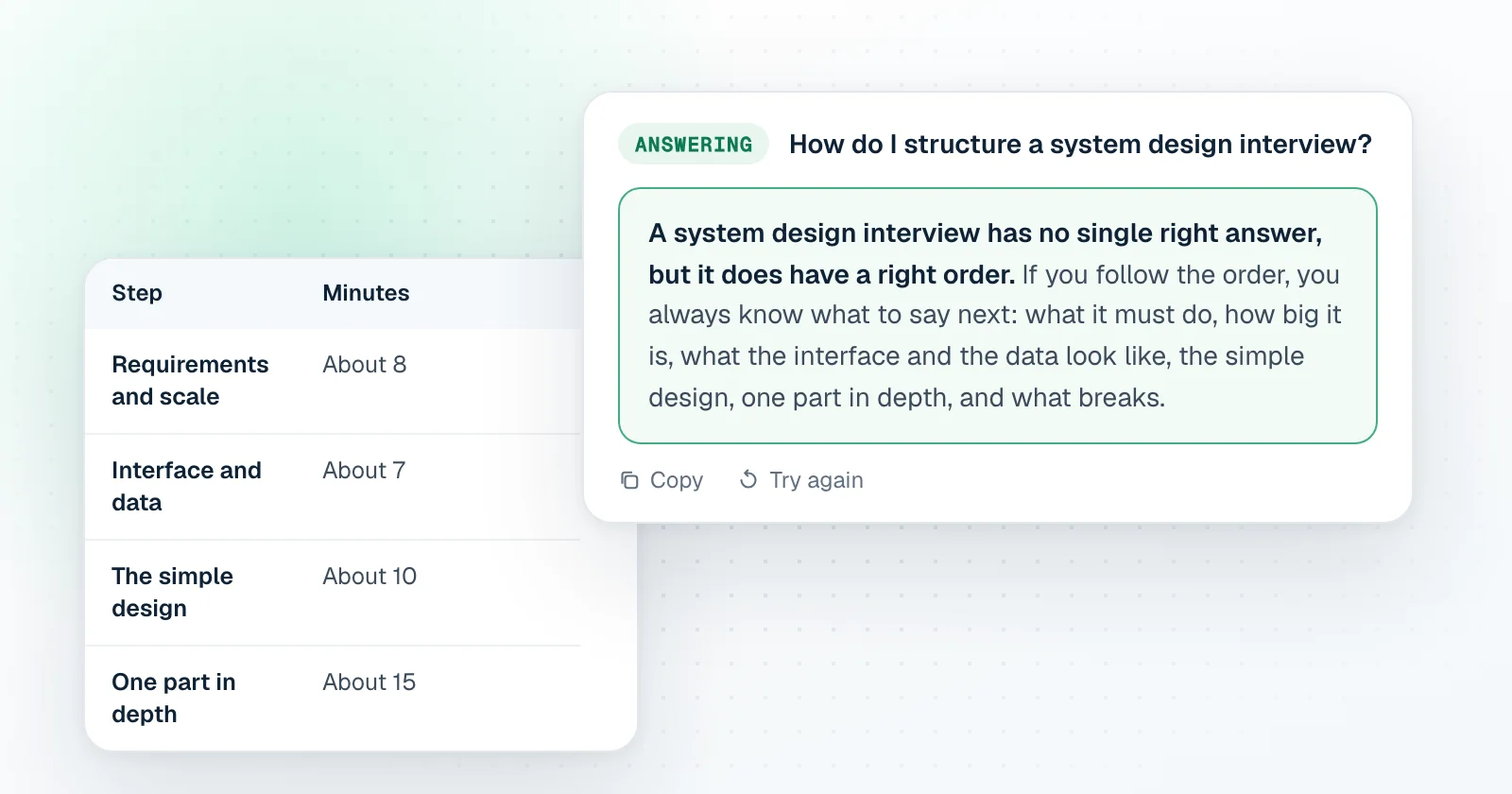
The six steps
- Requirements. What must it do, and what can it skip? Then the qualities: how fast, how available, how consistent.
- Scale. Rough numbers only: users, requests per second, size of the data. Enough to choose between designs.
- Interface and data. The two or three calls the system offers, and the main records it stores.
- The simple design. A few boxes that would work for a small version. Draw it before you improve it.
- One part in depth. Pick the hardest part, or let the interviewer pick, and design it properly.
- What breaks. Where it fails, what you gave up, and what you would watch.
Splitting forty-five minutes
| Step | Minutes |
|---|---|
| Requirements and scale | About 8 |
| Interface and data | About 7 |
| The simple design | About 10 |
| One part in depth | About 15 |
| What breaks | About 5 |
Say the trade-off every time you choose
"I will use a queue here" is half an answer. "I will use a queue here, so a slow payment provider does not block checkout. The cost is that the customer hears about a failure later, not at once" is the whole one. Interviewers are grading the second sentence.
Common mistakes
- Drawing boxes before asking what the system is for.
- Spending fifteen minutes on arithmetic that changes no decision.
- Naming technologies instead of saying what they are for.
- Defending the first design. Changing your mind out loud is a strength.
When you do not know a part
Say so and reason from what you do know. Nobody has built every kind of system. What the interviewer wants to see is how you think about a part you have not built yet.