
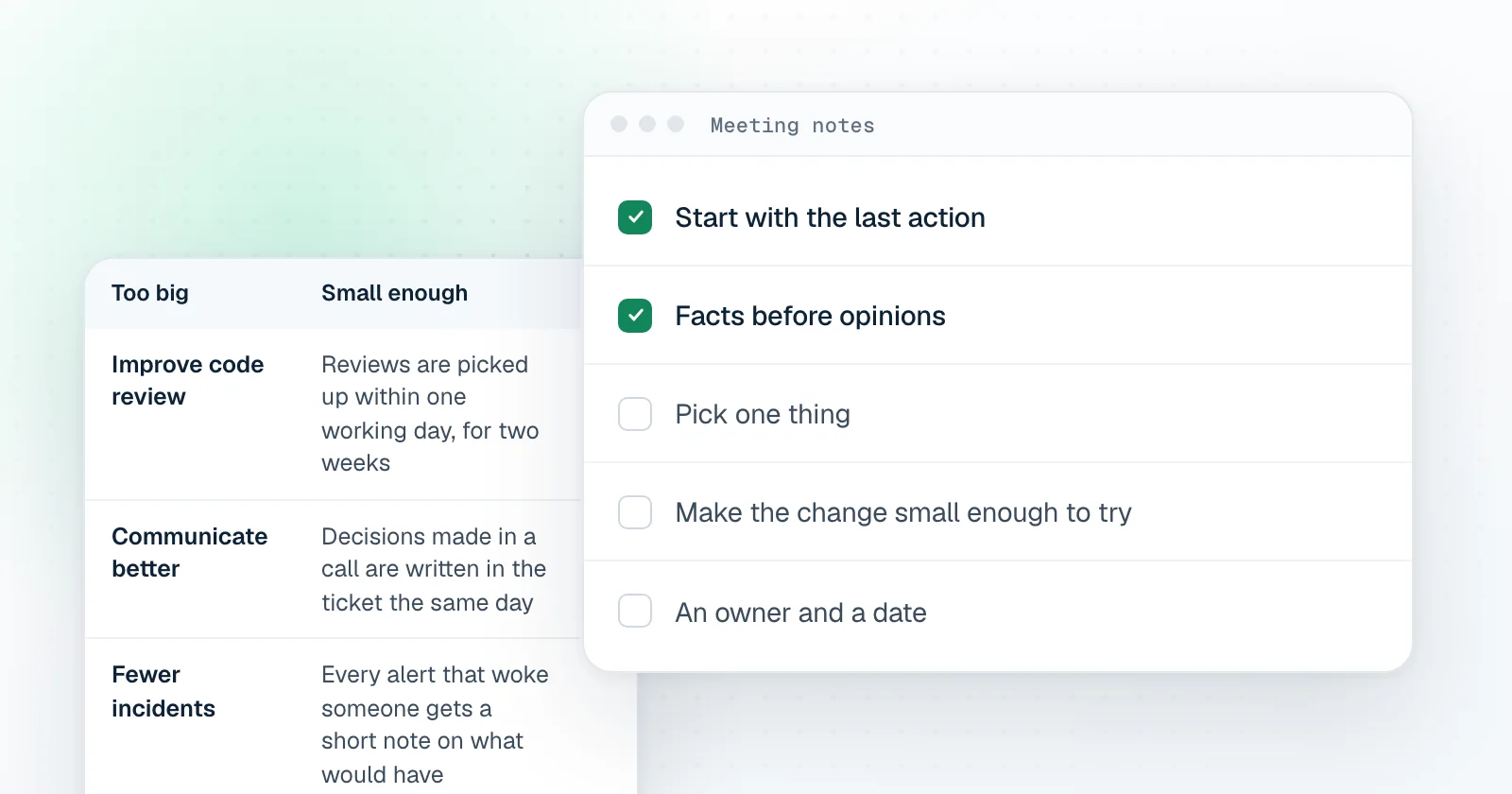
Start with the last action
Open with one question: what happened to the thing we agreed to change last time? If it was done, say what difference it made. If it was not, find out why before adding anything new. A team that skips this step learns that retrospective actions do not matter.
Facts before opinions
- What shipped, and what did not.
- What broke, and how long it took to notice.
- Where work waited: for a review, a decision, another team.
Ten minutes on what actually happened makes the rest of the hour about the work instead of about feelings regarding the work.
Pick one thing
Let people name problems, group them, and vote. Then take the top one and stop. One change that happens is worth more than five that are written down. The other four will still be there next time if they matter.
Make the change small enough to try
| Too big | Small enough |
|---|---|
| Improve code review | Reviews are picked up within one working day, for two weeks |
| Communicate better | Decisions made in a call are written in the ticket the same day |
| Fewer incidents | Every alert that woke someone gets a short note on what would have prevented it |
An owner and a date
The owner is one person, not the team. The date is when you will look at whether it worked, usually the next retrospective. Without both, it is a wish.
Keep blame out of the room
Talk about what the system allowed, not about who did it. "The deploy script let us ship without the migration" leads to a fix. "Someone forgot the migration" leads to silence in the next retrospective.