
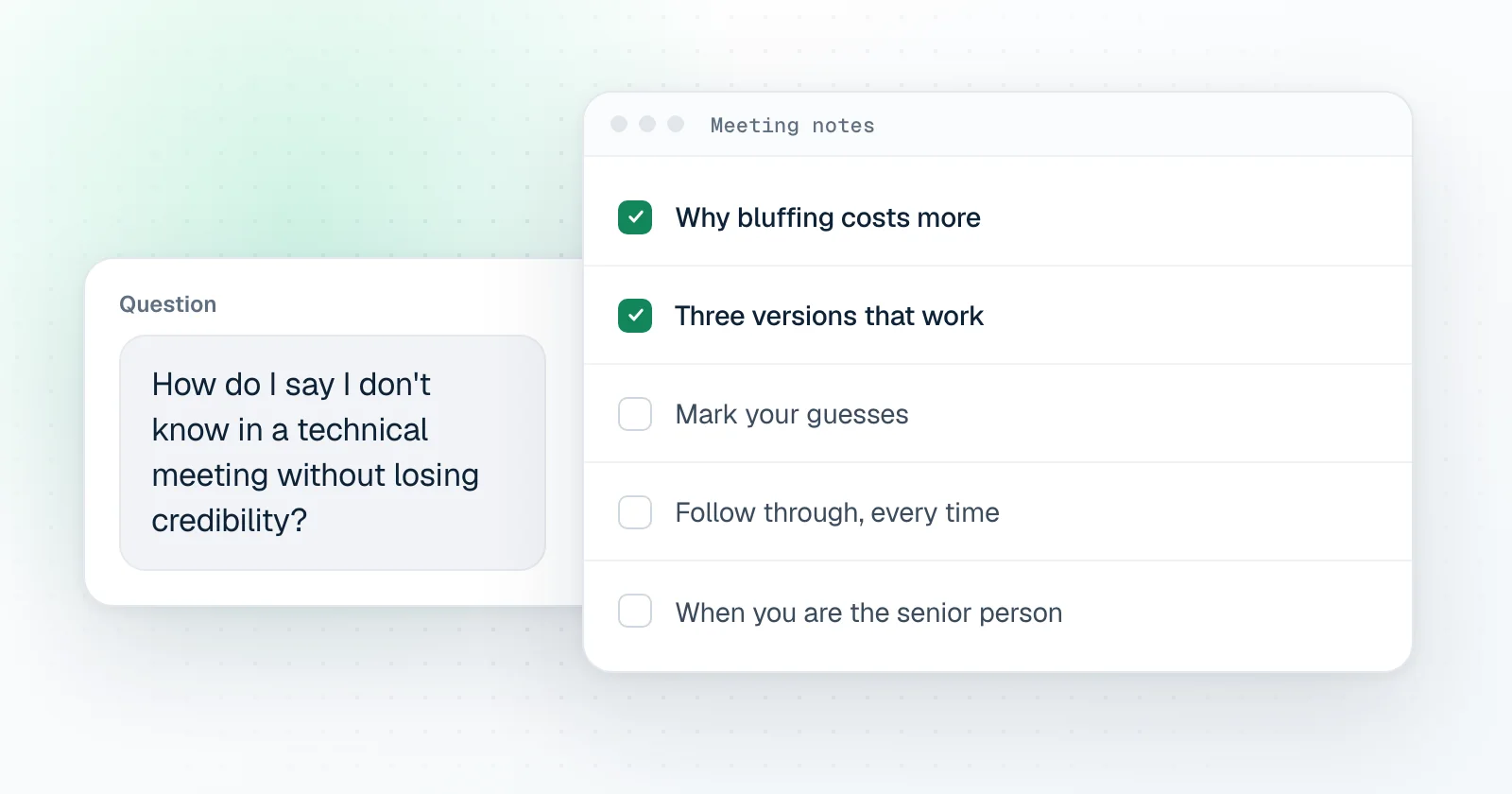
Why bluffing costs more
A confident wrong answer gets acted on. Someone plans around it, an estimate is built on it, and the error surfaces a week later with your name attached. An honest gap costs a few minutes. A bluff costs the next ten things you say.
Three versions that work
- With a time: "I don't know. I will check and tell you before the end of the day."
- With a method: "I don't know, but I know where to look. The retry settings live in the queue consumer."
- With the part you do know: "I know the charge function makes one attempt. I have not checked what the worker does with a failed job."
Mark your guesses
Sometimes a guess is what the meeting needs. Give it, and label it: "My guess is that it retries, but I have not read that code." A marked guess is useful. An unmarked one is a bluff that happens to be honest in your own head.
Follow through, every time
The sentence only works if the answer arrives. Write the question down when you say it, find the answer, and send it to everyone who was in the room, not only to the person who asked. After you have done this a few times, your "I don't know" starts to carry weight.
When you are the senior person
Say it more, not less. A senior engineer who says "I don't know, let us look" gives everyone else permission to do the same, and a team where people admit gaps finds its bugs earlier.
When someone else is bluffing
Do not call it out. Ask for the source: "Where is that in the code? I would like to read it." If it is there, you learn something. If it is not, the room finds out without anyone being accused.