
Four steps
- Say it plainly. "I have not used Kafka in production."
- Name the closest thing. "I have run RabbitMQ for three years."
- Map the concepts. "So I know queues, consumers, retries, and what happens when a consumer falls behind. As I understand it, the main difference is that Kafka keeps an ordered log, and each consumer reads it at its own position."
- Show how you learn. One short, real example of picking up a tool for a project.
Why this works
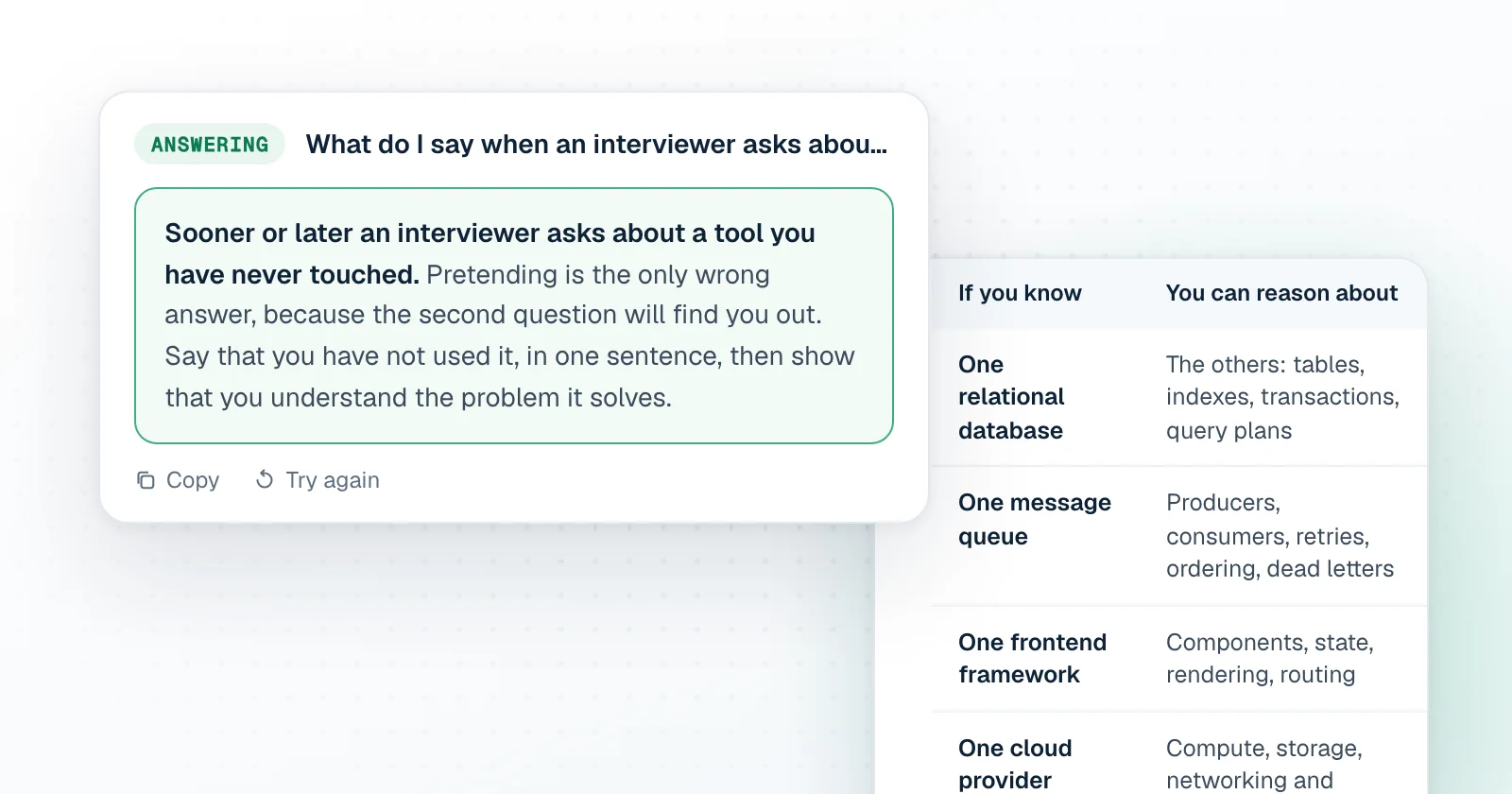
Tools change every few years. What an interviewer is really checking is whether you understand the category: what problem this kind of tool solves, and what goes wrong with it. Someone who knows one message queue well can be useful with another fairly soon, and interviewers know that.
Know the neighbours of your own tools
| If you know | You can reason about |
|---|---|
| One relational database | The others: tables, indexes, transactions, query plans |
| One message queue | Producers, consumers, retries, ordering, dead letters |
| One frontend framework | Components, state, rendering, routing |
| One cloud provider | Compute, storage, networking and identity on the others |
What not to do
- Do not say "I am familiar with it" when you have read one article.
- Do not list a tool on your CV if you cannot answer one follow-up about it.
- Do not apologize for three sentences. One is enough.
- Do not change the subject without answering.
If the job is built on that tool
Then it is a real gap, and it is fair for them to weigh it. Say what you would do in your first month to close it, and ask how long it took others on the team. Sometimes the honest outcome is that the role is not a fit yet. That is better learned in the interview than in the third week.
Before the interview
Read the job post for tools you have not used, and spend half an hour on each: what it is for, the three or four words that belong to it, and how it differs from what you know. You are not trying to fake experience. You are making sure you can hold a conversation.