
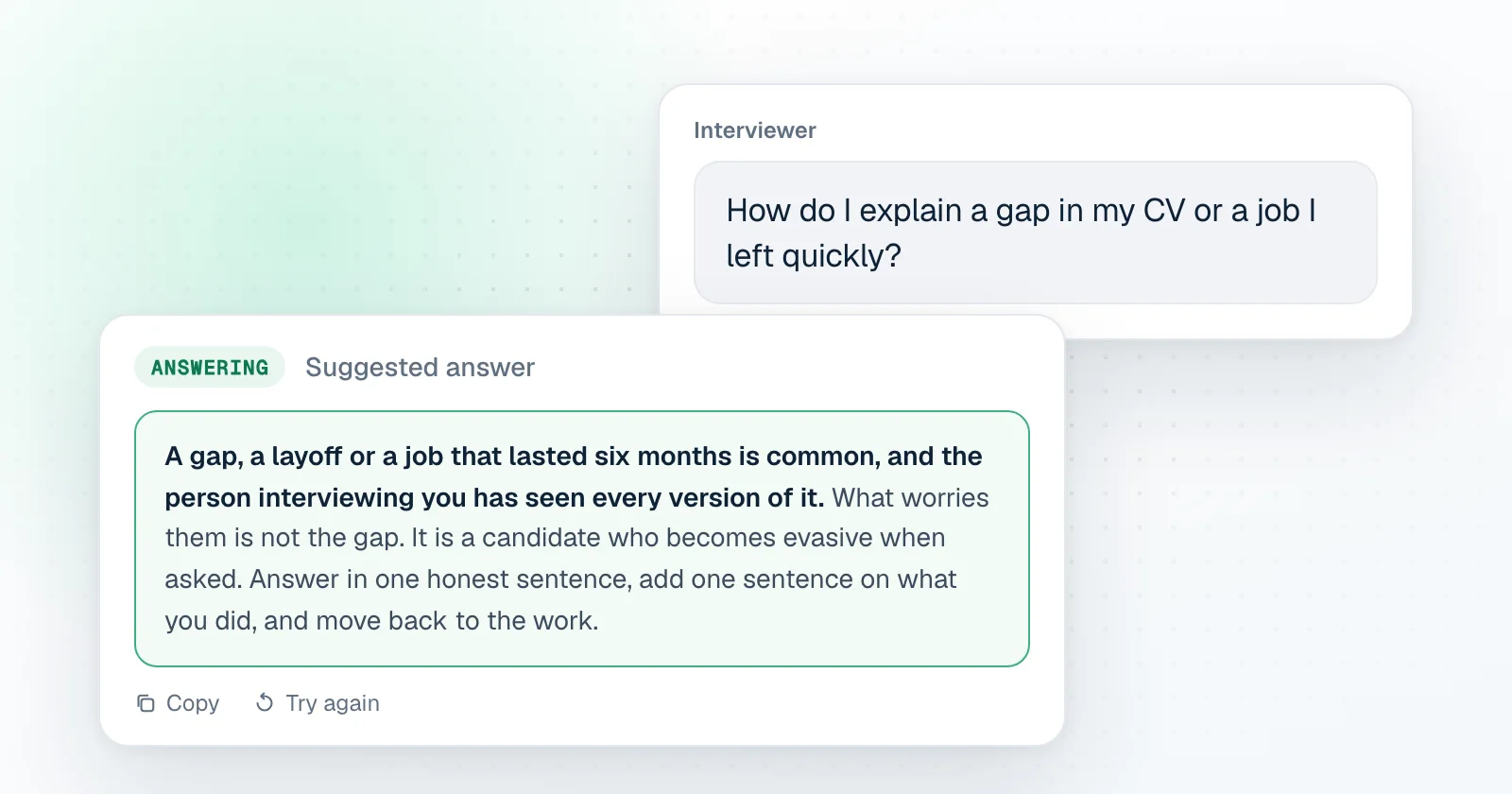
The shape of the answer
- What happened, in one sentence, without blame.
- What you did with the time, in one sentence, if it is relevant.
- Why you are here now.
Examples
- A layoff: "My team was cut in a company-wide layoff in March. I took two months off, and since then I have been working on a side project in Go and interviewing."
- Family or health: "I took a year away from work for family reasons. That is resolved, and I have been doing contract work since January."
- A job that did not fit: "I left after six months. The role turned out to be mostly support for an old system, and I wanted to build. I should have asked more about the day-to-day work before joining, and now I do."
- A break: "I took eight months off after six years of work. I am glad I did, and I am ready to be back."
You decide how much to share
You do not owe an interviewer the details of your health or your family. "For personal reasons, which are resolved" is a complete answer, and a reasonable interviewer moves on. What an employer may ask differs from country to country.
Do not blame
Even when the last employer deserves it. A candidate who criticizes a former manager makes the interviewer picture being described the same way. "It was not the right fit" and one neutral fact are enough.
Several short jobs in a row
One short job needs a sentence. Three need a pattern: what you were looking for, why each one was not it, and why this role is different. If there is a real lesson in it, say it. Interviewers respond well to someone who has clearly thought about their own choices.
On the CV itself
- Use years, or months and years, consistently. Do not stretch dates to hide a gap. Dates get checked.
- A gap of a few months needs no explanation on paper.
- If you did something relevant during it, such as a course, a project or freelance work, give it one line.