
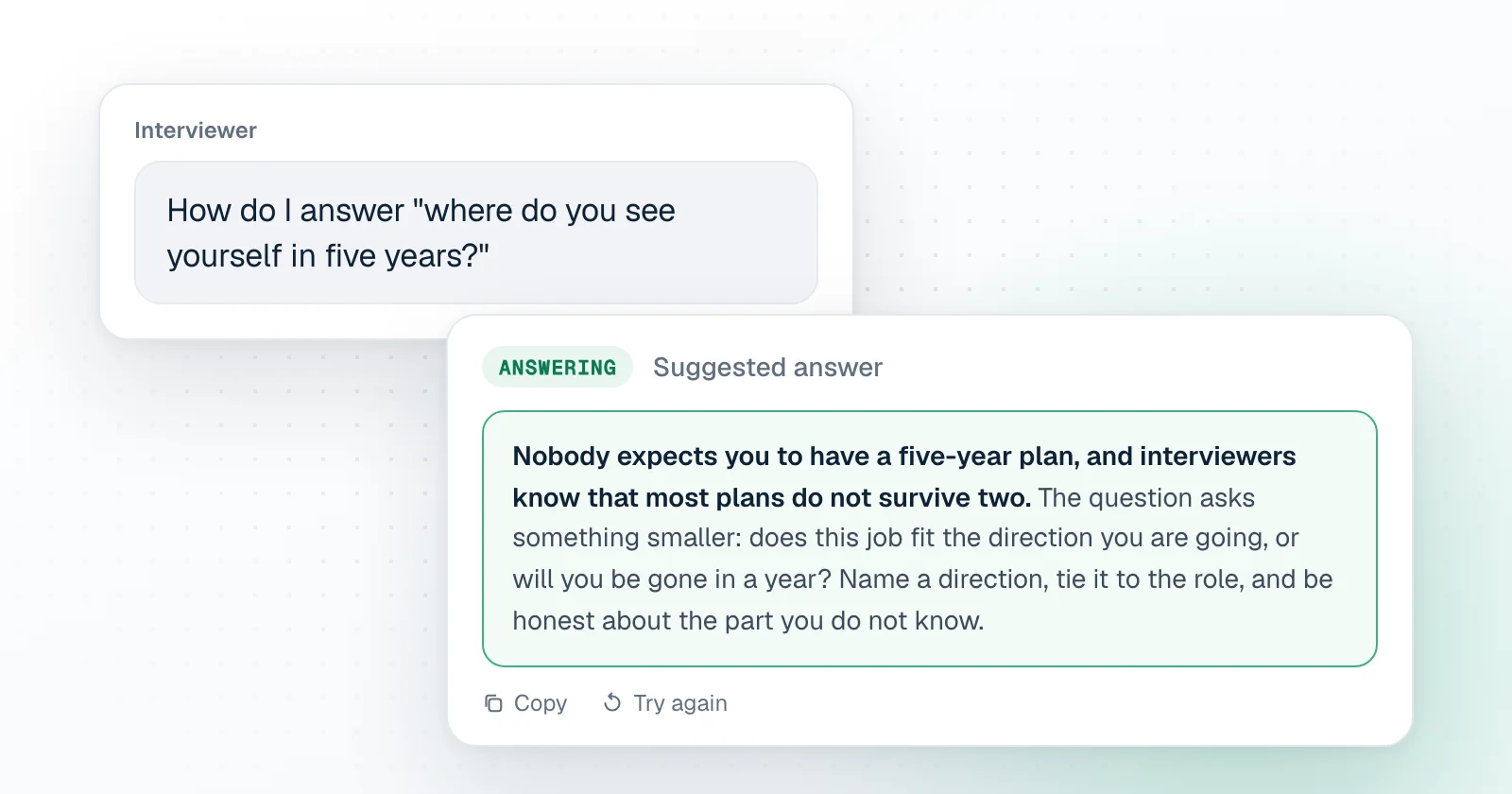
What they are listening for
- That you have thought about your work at all.
- That the role is a step toward what you want, not away from it.
- That what you want is something this company can offer.
A direction, not a title
"I want to be a staff engineer" is a title, and it invites the question why. "I want to be the person a team trusts with the hardest part of the system" is a direction. It says what kind of work you want more of, and it is true at any level.
Three honest shapes
- Deeper. "I want to get very good at distributed data, and this team works on exactly that."
- Broader. "I have been a backend engineer for five years. I want to own a whole product area, from the database to what the user sees."
- Toward people. "I enjoy mentoring, and I would like to find out whether leading a team suits me. I want to do that somewhere I have first earned it as an engineer."
If you do not know
Say what you do know. "I am not sure whether I will want to manage or stay technical. What I know is that I want to keep working on systems where reliability matters, and to be learning from people who are better than me." That is a complete and credible answer.
What to avoid
- "In your chair." Interviewers have heard it many times.
- A plan that has nothing to do with this job: starting a company, moving to another field.
- "I have not thought about it."
- A precise ladder of titles and dates.
Tie it back to the role
End with one sentence on why this job is the next step in that direction. It turns an abstract question into a reason to hire you.